Fallser Kitchen · November 1999
Sweet potatoes versus yams
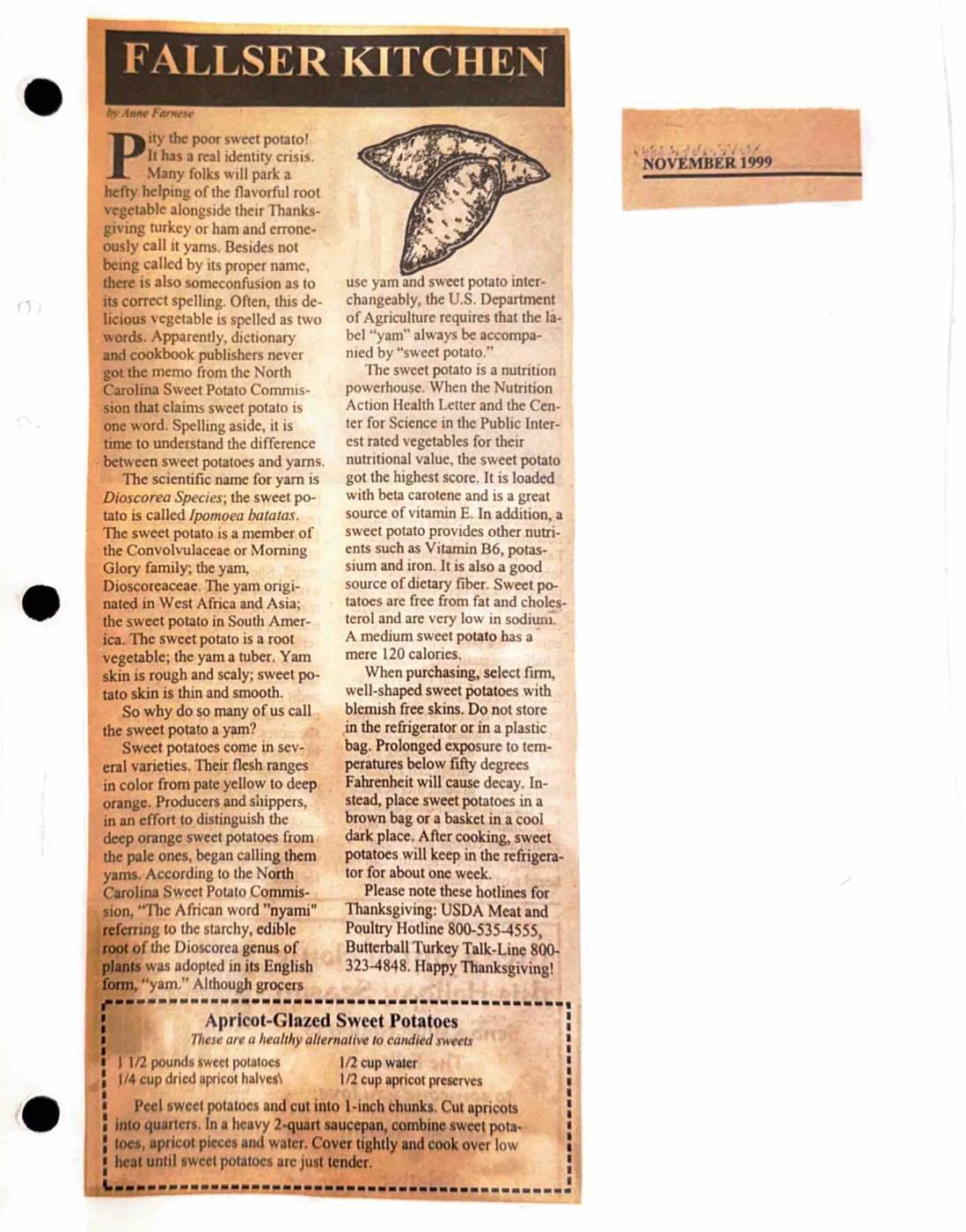
Pity the poor sweet potato! It has a real identity crisis. Many folks will park a hefty helping of the flavorful root vegetable alongside their Thanksgiving turkey or ham and erroneously call it yams. Besides not being called by its proper name, there is also some confusion as to its correct spelling. Often, this delicious vegetable is spelled as two words. Apparently, dictionary and cookbook publishers never got the memo from the North Carolina Sweet Potato Commission that claims sweet potato is one word. Spelling aside, it is time to understand the difference between sweet potatoes and yams.
The scientific name for yam is Dioscorea Species; the sweet potato is called Ipomoea batatas. The sweet potato is a member of the Convolvulaceae or Morning Glory family; the yam, Dioscoreaceae. The yam originated in West Africa and Asia; the sweet potato in South America. The sweet potato is a root vegetable; the yam a tuber. Yam skin is rough and scaly; sweet potato skin is thin and smooth.
So why do so many of us call the sweet potato a yam?
Sweet potatoes come in several varieties. Their flesh ranges in color from pale yellow to deep orange. Producers and shippers, in an effort to distinguish the deep orange sweet potatoes from the pale ones, began calling them yams. According to the North Carolina Sweet Potato Commission, "The African word "nyami" referring to the starchy, edible root of the Dioscorea genus of plants was adopted in its English form, "yam." Although grocers use yam and sweet potato interchangeably, the U.S. Department of Agriculture requires that the label "yam" always be accompanied by "sweet potato."
The sweet potato is a nutrition powerhouse. When the Nutrition Action Health Letter and the Center for Science in the Public Interest rated vegetables for their nutritional value, the sweet potato got the highest score. It is loaded with beta carotene and is a great source of vitamin E. In addition, a sweet potato provides other nutrients such as Vitamin B6, potassium and iron. It is also a good source of dietary fiber. Sweet potatoes are free from fat and cholesterol and are very low in sodium. A medium sweet potato has a mere 120 calories.
When purchasing, select firm, well-shaped sweet potatoes with blemish free skins. Do not store in the refrigerator or in a plastic bag. Prolonged exposure to temperatures below fifty degrees Fahrenheit will cause decay. Instead, place sweet potatoes in a brown bag or a basket in a cool dark place. After cooking, sweet potatoes will keep in the refrigerator for about one week.
Please note these hotlines for Thanksgiving: USDA Meat and Poultry Hotline 800-535-4555, Butterball Turkey Talk-Line 800-323-4848. Happy Thanksgiving!
Apricot-Glazed Sweet Potatoes
These are a healthy alternative to candied sweets
Ingredients
- 1½ pounds sweet potatoes
- ¼ cup dried apricot halves
- ½ cup water
- ½ cup apricot preserves
Directions
- Peel sweet potatoes and cut into 1-inch chunks. Cut apricots into quarters.
- In a heavy 2-quart saucepan, combine sweet potatoes, apricot pieces and water. Cover tightly and cook over low heat until sweet potatoes are just tender.
View the original clipping
vegetables ingredients-spotlight holidays