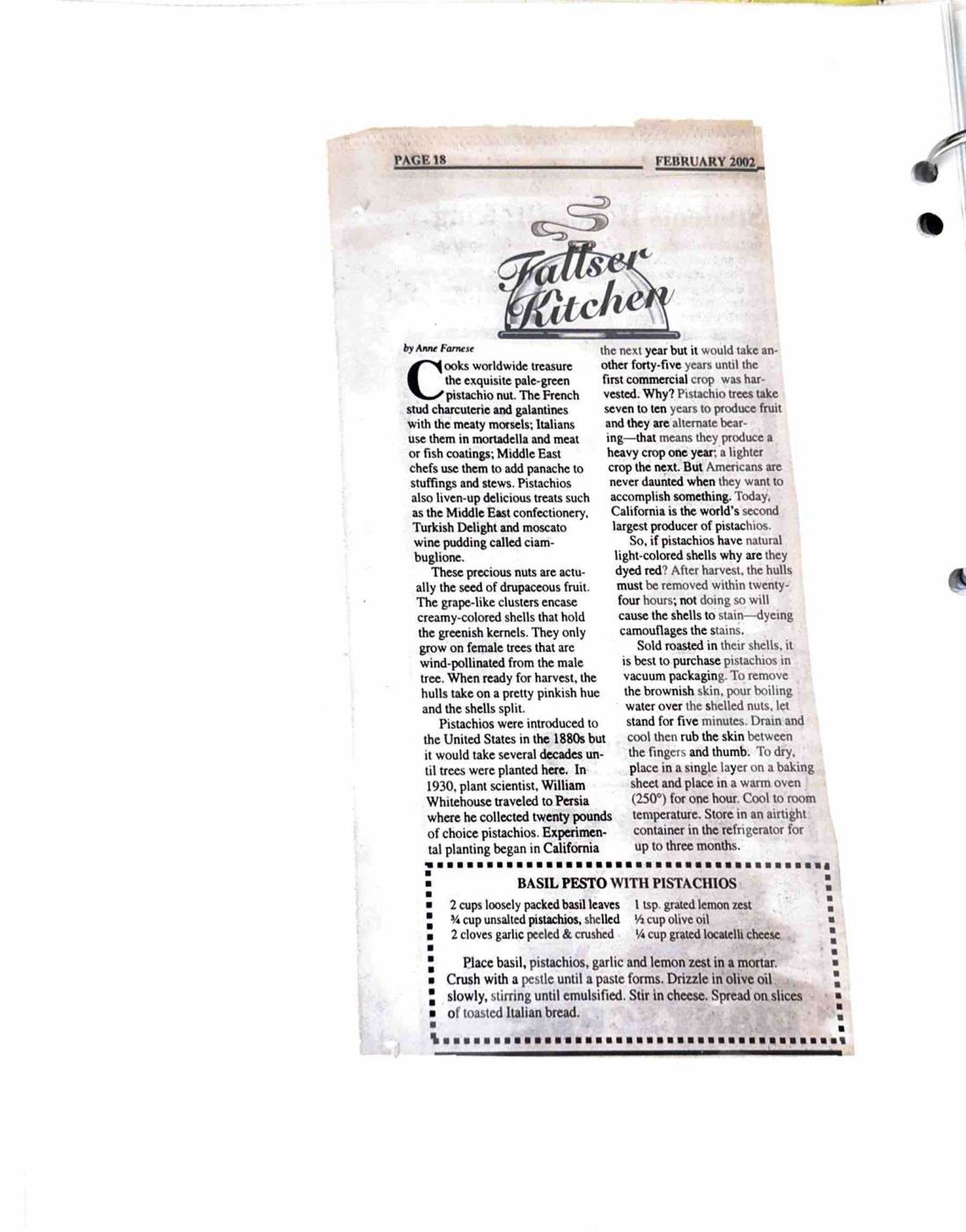
Fallser Kitchen · February 2002
Pistachio history and handling
Cooks worldwide treasure the exquisite pale-green pistachio nut. The French stud charcuterie and galantines with the meaty morsels; Italians use them in mortadella and meat or fish coatings; Middle East chefs use them to add panache to stuffings and stews. Pistachios also liven-up delicious treats such as the Middle East confectionery, Turkish Delight and moscato wine pudding called ciambuglione.
These precious nuts are actually the seed of drupaceous fruit. The grape-like clusters encase creamy-colored shells that hold the greenish kernels. They only grow on female trees that are wind-pollinated from the male tree. When ready for harvest, the hulls take on a pretty pinkish hue and the shells split.
Pistachios were introduced to the United States in the 1880s but it would take several decades until trees were planted here. In 1930, plant scientist, William Whitehouse traveled to Persia where he collected twenty pounds of choice pistachios. Experimental planting began in California the next year but it would take another forty-five years until the first commercial crop was harvested. Why? Pistachio trees take seven to ten years to produce fruit and they are alternate bearing—that means they produce a heavy crop one year; a lighter crop the next. But Americans are never daunted when they want to accomplish something. Today, California is the world's second largest producer of pistachios.
So, if pistachios have natural light-colored shells why are they dyed red? After harvest, the hulls must be removed within twenty-four hours; not doing so will cause the shells to stain—dyeing camouflages the stains.
Sold roasted in their shells, it is best to purchase pistachios in vacuum packaging. To remove the brownish skin, pour boiling water over the shelled nuts, let stand for five minutes. Drain and cool then rub the skin between the fingers and thumb. To dry, place in a single layer on a baking sheet and place in a warm oven (250°) for one hour. Cool to room temperature. Store in an airtight container in the refrigerator for up to three months.
Basil Pesto with Pistachios
Ingredients
- 2 cups loosely packed basil leaves
- ¾ cup unsalted pistachios, shelled
- 2 cloves garlic peeled & crushed
- 1 tsp. grated lemon zest
- ½ cup olive oil
- ¼ cup grated locatelli cheese
Directions
- Place basil, pistachios, garlic and lemon zest in a mortar. Crush with a pestle until a paste forms.
- Drizzle in olive oil slowly, stirring until emulsified. Stir in cheese. Spread on slices of toasted Italian bread.
View the original clipping
ingredients-spotlight condiments-sauces