Fallser Kitchen · December 2002
Santa lucia feast traditions
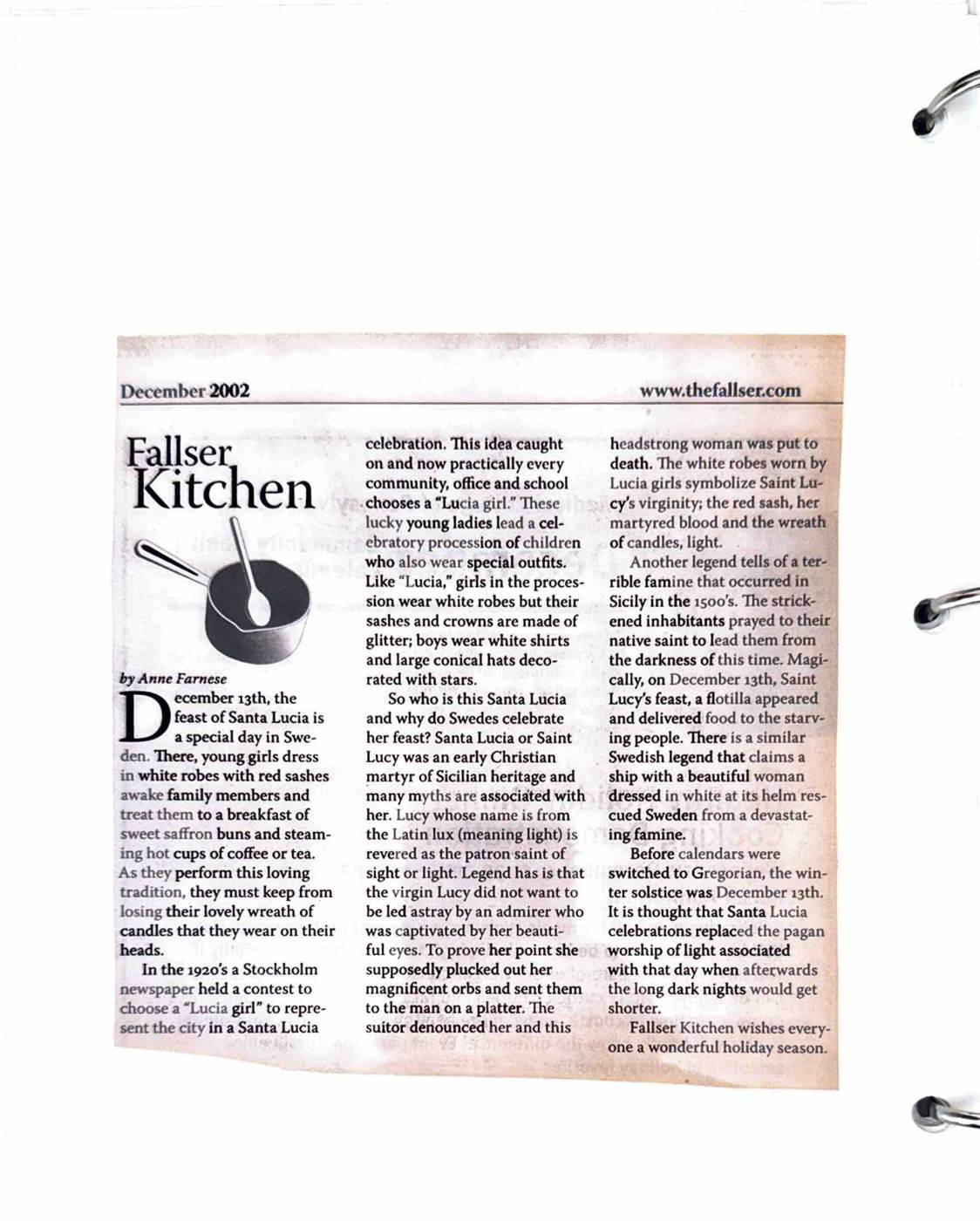
December 13th, the feast of Santa Lucia is a special day in Sweden. There, young girls dress in white robes with red sashes awake family members and treat them to a breakfast of sweet saffron buns and steaming hot cups of coffee or tea. As they perform this loving tradition, they must keep from losing their lovely wreath of candles that they wear on their heads.
In the 1920's a Stockholm newspaper held a contest to choose a "Lucia girl" to represent the city in a Santa Lucia celebration. This idea caught on and now practically every community, office and school chooses a "Lucia girl." These lucky young ladies lead a celebratory procession of children who also wear special outfits. Like "Lucia," girls in the procession wear white robes but their sashes and crowns are made of glitter; boys wear white shirts and large conical hats decorated with stars.
So who is this Santa Lucia and why do Swedes celebrate her feast? Santa Lucia or Saint Lucy was an early Christian martyr of Sicilian heritage and many myths are associated with her. Lucy whose name is from the Latin lux (meaning light) is revered as the patron saint of sight or light. Legend has is that the virgin Lucy did not want to be led astray by an admirer who was captivated by her beautiful eyes. To prove her point she supposedly plucked out her magnificent orbs and sent them to the man on a platter. The suitor denounced her and this headstrong woman was put to death. The white robes worn by Lucia girls symbolize Saint Lucy's virginity; the red sash, her martyred blood and the wreath of candles, light.
Another legend tells of a terrible famine that occurred in Sicily in the 1500's. The strickened inhabitants prayed to their native saint to lead them from the darkness of this time. Magically, on December 13th, Saint Lucy's feast, a flotilla appeared and delivered food to the starving people. There is a similar Swedish legend that claims a ship with a beautiful woman dressed in white at its helm rescued Sweden from a devastating famine.
Before calendars were switched to Gregorian, the winter solstice was December 13th. It is thought that Santa Lucia celebrations replaced the pagan worship of light associated with that day when afterwards the long dark nights would get shorter.
Fallser Kitchen wishes everyone a wonderful holiday season.
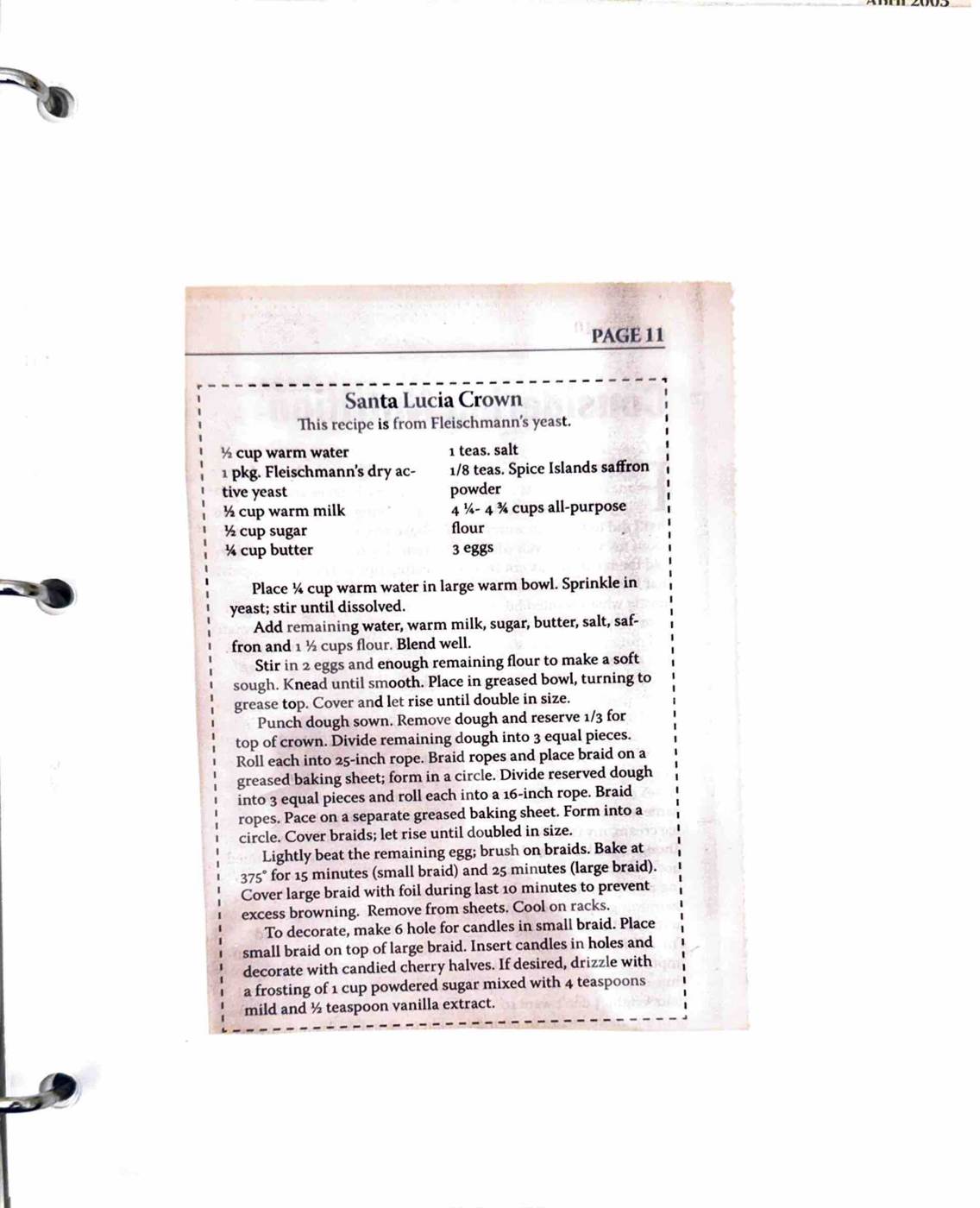
Santa Lucia Crown
This recipe is from Fleischmann's yeast.
Ingredients
- ½ cup warm water
- 1 pkg. Fleischmann's dry active yeast
- ½ cup warm milk
- ½ cup sugar
- ¼ cup butter
- 1 teas. salt
- ⅛ teas. Spice Islands saffron powder
- 4 ¼- 4 ¾ cups all-purpose flour
- 3 eggs
Directions
- Place ¼ cup warm water in large warm bowl. Sprinkle in yeast; stir until dissolved.
- Add remaining water, warm milk, sugar, butter, salt, saffron and 1 ½ cups flour. Blend well.
- Stir in 2 eggs and enough remaining flour to make a soft sough. Knead until smooth. Place in greased bowl, turning to grease top. Cover and let rise until double in size.
- Punch dough sown. Remove dough and reserve ⅓ for top of crown. Divide remaining dough into 3 equal pieces. Roll each into 25-inch rope. Braid ropes and place braid on a greased baking sheet; form in a circle. Divide reserved dough into 3 equal pieces and roll each into a 16-inch rope. Braid ropes. Pace on a separate greased baking sheet. Form into a circle. Cover braids; let rise until doubled in size.
- Lightly beat the remaining egg; brush on braids. Bake at 375° for 15 minutes (small braid) and 25 minutes (large braid). Cover large braid with foil during last 10 minutes to prevent excess browning. Remove from sheets. Cool on racks.
- To decorate, make 6 hole for candles in small braid. Place small braid on top of large braid. Insert candles in holes and decorate with candied cherry halves. If desired, drizzle with a frosting of 1 cup powdered sugar mixed with 4 teaspoons mild and ½ teaspoon vanilla extract.
View the original clipping
holidays breads baking