Fallser Kitchen · August 2003
History of vanilla, part i
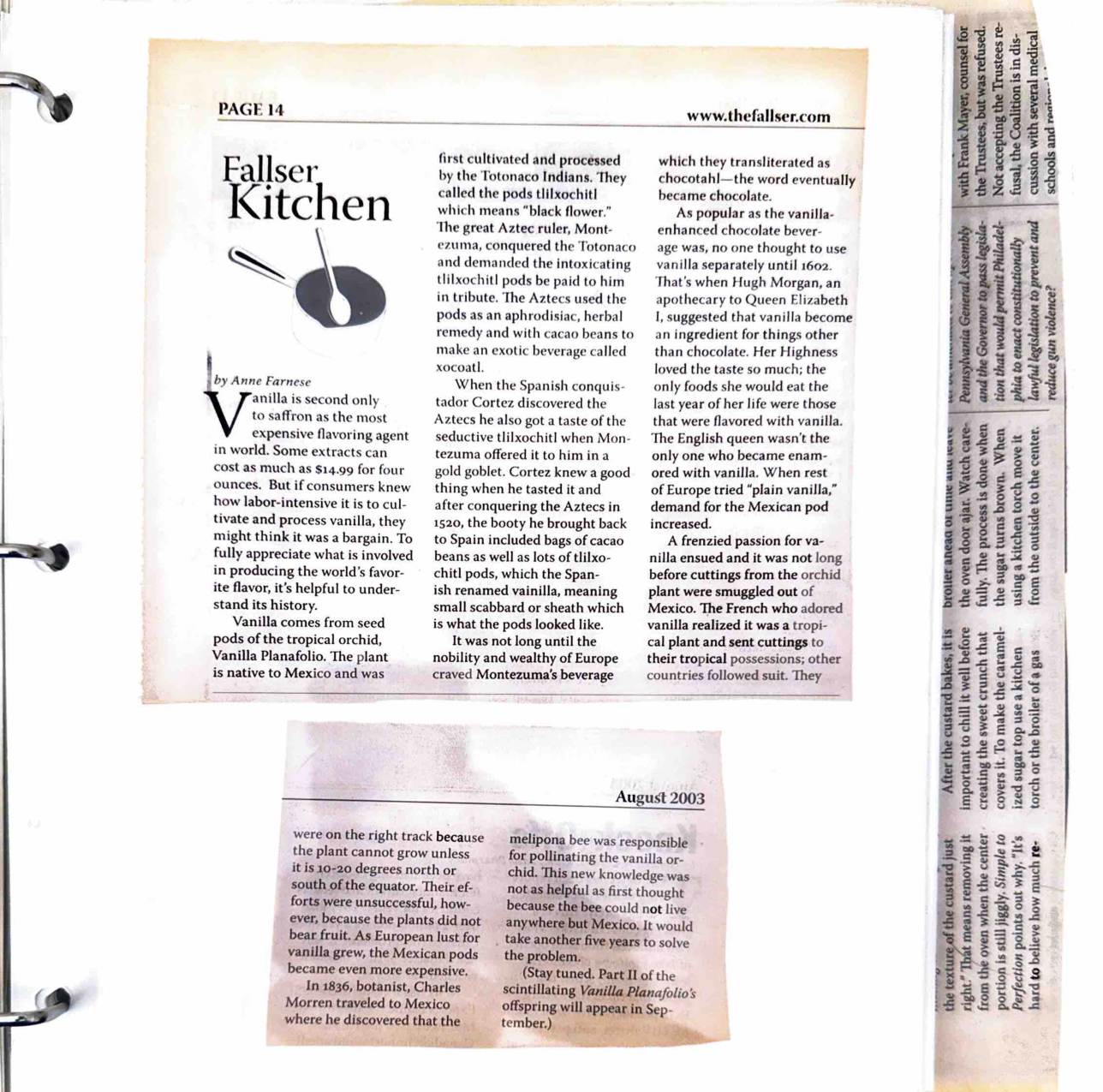
Vanilla is second only to saffron as the most expensive flavoring agent in world. Some extracts can cost as much as $14.99 for four ounces. But if consumers knew how labor-intensive it is to cultivate and process vanilla, they might think it was a bargain. To fully appreciate what is involved in producing the world's favorite flavor, it's helpful to understand its history.
Vanilla comes from seed pods of the tropical orchid, Vanilla Planafolio. The plant is native to Mexico and was first cultivated and processed by the Totonaco Indians. They called the pods tlilxochitl which means "black flower." The great Aztec ruler, Montezuma, conquered the Totonaco and demanded the intoxicating tlilxochitl pods be paid to him in tribute. The Aztecs used the pods as an aphrodisiac, herbal remedy and with cacao beans to make an exotic beverage called xocoatl.
When the Spanish conquistador Cortez discovered the Aztecs he also got a taste of the seductive tlilxochitl when Montezuma offered it to him in a gold goblet. Cortez knew a good thing when he tasted it and after conquering the Aztecs in 1520, the booty he brought back to Spain included bags of cacao beans as well as lots of tlilxochitl pods, which the Spanish renamed vainilla, meaning small scabbard or sheath which is what the pods looked like.
It was not long until the nobility and wealthy of Europe craved Montezuma's beverage which they transliterated as chocotahl—the word eventually became chocolate.
As popular as the vanilla-enhanced chocolate beverage was, no one thought to use vanilla separately until 1602. That's when Hugh Morgan, an apothecary to Queen Elizabeth I, suggested that vanilla become an ingredient for things other than chocolate. Her Highness loved the taste so much; the only foods she would eat the last year of her life were those that were flavored with vanilla. The English queen wasn't the only one who became enamored with vanilla. When rest of Europe tried "plain vanilla," demand for the Mexican pod increased.
A frenzied passion for vanilla ensued and it was not long before cuttings from the orchid plant were smuggled out of Mexico. The French who adored vanilla realized it was a tropical plant and sent cuttings to their tropical possessions; other countries followed suit. They were on the right track because the plant cannot grow unless it is 10-20 degrees north or south of the equator. Their efforts were unsuccessful, however, because the plants did not bear fruit. As European lust for vanilla grew, the Mexican pods became even more expensive.
In 1836, botanist, Charles Morren traveled to Mexico where he discovered that the melipona bee was responsible for pollinating the vanilla orchid. This new knowledge was not as helpful as first thought because the bee could not live anywhere but Mexico. It would take another five years to solve the problem.
(Stay tuned. Part II of the scintillating Vanilla Planafolio's offspring will appear in September.)
View the original clipping
ingredients-spotlight