Fallser Kitchen · April 2004
Eggs in spring celebrations
Eggs have figured prominently in vernal celebrations since the earliest day of mankind. As they are a symbol of new life, it is natural to assume that is why eggs are associated with spring—the time when earth is reborn. This assumption is true but not entirely. Although ancestors of today's fowl were domesticated as early as 2000 B.C., their eggs were seasonal. Because hens need twelve hours of light to lay eggs, regular production was not year round. It is not surprising then that eggs became part of celebrating spring.
One such celebration was the pagan festival of Ostara that was held in honor of Eostre, the goddess of spring. The observance included giving gifts of eggs. During the development of Christianity, religious persecution was a threat so missionaries adopted the pagan springtime celebration but with a twist. Early Christians were taught the egg symbolized the rebirth of man instead of the earth.
Eggs are still associated with spring and sometimes whole ones are fashioned into seasonal baked goods. Southern Italians arrange them in sweet dough that is formed in the shape of a wreath or dove and Greeks put red ones in tsourcki.
Perhaps the most popular treatment of eggs in spring is to paint, dye or decorate them. The practice of coloring or adorning eggs is not new. Ancient man used leaves and flowers to color eggs as well as gold. It is documented that in 1290 Edward I had 450 eggs gold-leafed then gave them to his servants.
Most folks hard-cook eggs before coloring them. The best way to do this is to cover eggs by one inch with tap water. Turn the heat to medium, cover and bring to a boil. When water boils, turn off the heat and let stand for fifteen minutes. Pour off the hot water and rinse eggs in cold running water for five minutes. Store eggs in the refrigerator.
Easter Egg Bread
This is a luscious, lemony treat.
Ingredients
- ¼ cup sugar
- 1 teaspoon salt
- 1 package active dry yeast
- 3½ cups all purpose flour
- 2 tablespoons butter
- ⅔ cup milk
- 9 eggs
- 2 tablespoons grated lemon peel
- Easter egg coloring kit
- 1 teaspoon water
Directions
- In bowl, mix sugar, salt, yeast, and 1 cup flour. Heat butter and milk until warm. With mixer at low speed, beat liquid into dry ingredients. At medium, beat 2 minutes. Beat in 2 eggs, 1 egg white, and ¾ cup flour, beat 2 minutes. Stir in lemon peel and 1¼ cups flour. On floured surface, knead dough about 5 minutes, working in about ½ cup flour, place in greased bowl, turning to grease top. Cover, let rise in warm place until doubled, about 1½ hours.
- Meanwhile, dye 6 eggs your favorite colors, following label directions from Easter egg coloring kit, but do not hard cook eggs, set aside.
- Punch down dough, turn onto floured surface, cover for 25 minutes.
- Grease large cookie sheet. Cut dough in half, form each half into a 30 inch long rope. On cookie sheet, twist ropes together to form ring, leaving holes for 5 eggs. Cover, let rise until doubled, about 1½ hours.
- Preheat oven to 350F. Insert raw, colored eggs into holes in twist, place 1 egg in center. In cup, beat egg yolk with water, use to brush dough. Bake 30 minutes or until golden. Cool on wire rack.
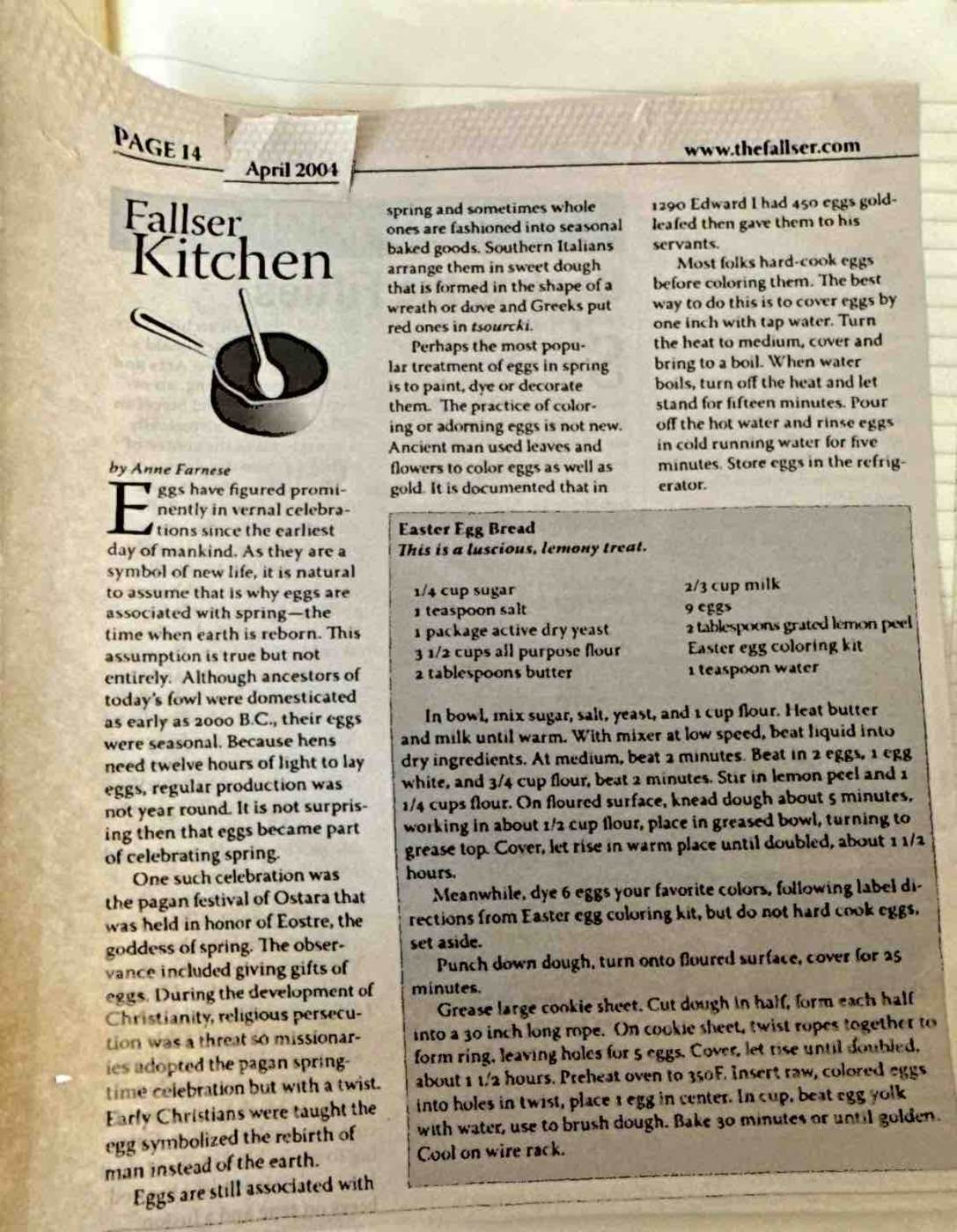
View the original clipping
breads holidays baking