Fallser Kitchen · December 2014
Cookie history and baking tips
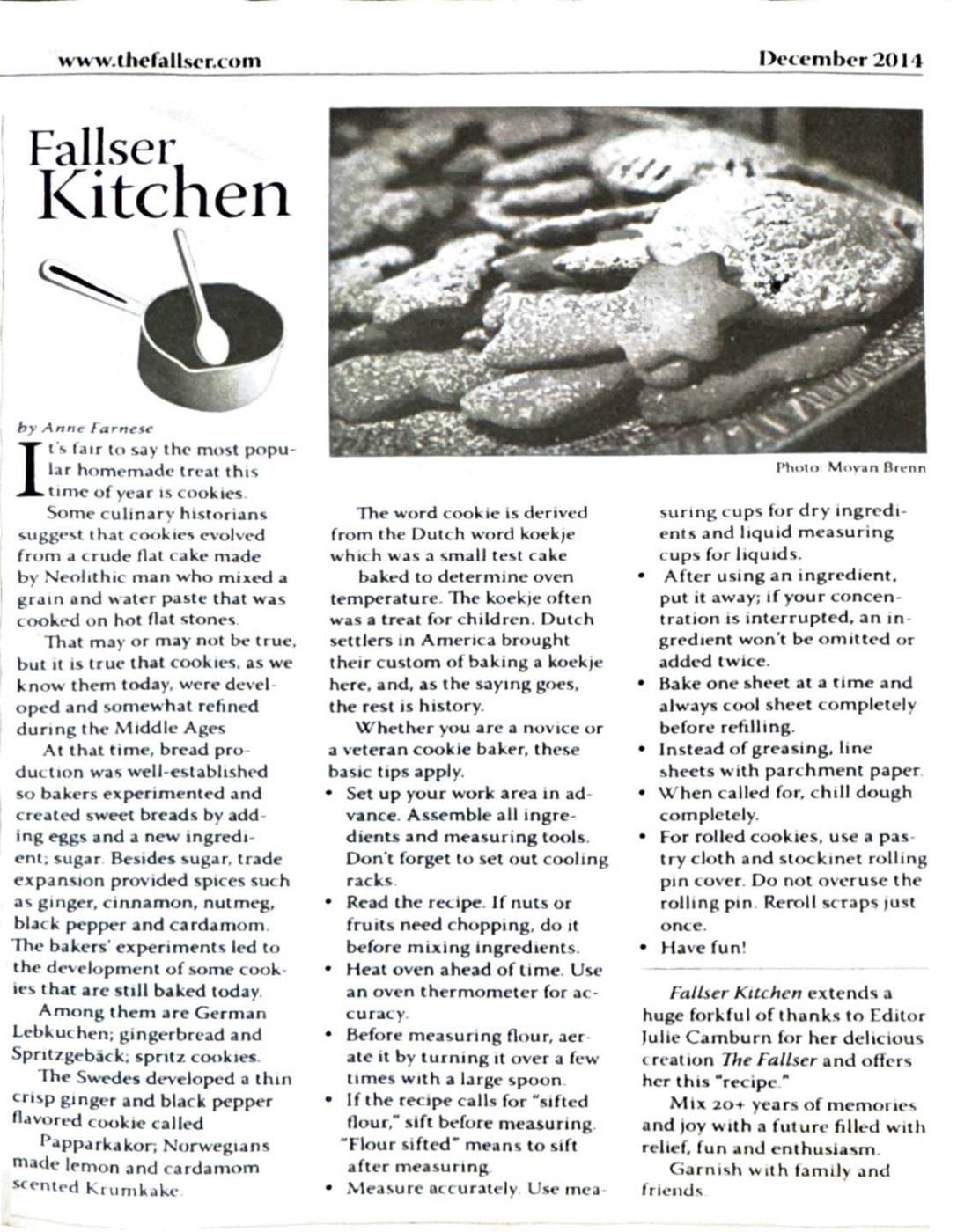
It's fair to say the most popular homemade treat this time of year is cookies.
Some culinary historians suggest that cookies evolved from a crude flat cake made by Neolithic man who mixed a grain and water paste that was cooked on hot flat stones.
That may or may not be true, but it is true that cookies, as we know them today, were developed and somewhat refined during the Middle Ages.
At that time, bread production was well-established so bakers experimented and created sweet breads by adding eggs and a new ingredient; sugar. Besides sugar, trade expansion provided spices such as ginger, cinnamon, nutmeg, black pepper and cardamom. The bakers' experiments led to the development of some cookies that are still baked today.
Among them are German Lebkuchen; gingerbread and Spritzgebäck; spritz cookies. The Swedes developed a thin crisp ginger and black pepper flavored cookie called Papparkakor; Norwegians made lemon and cardamom scented Krumkake.
The word cookie is derived from the Dutch word koekje which was a small test cake baked to determine oven temperature. The koekje often was a treat for children. Dutch settlers in America brought their custom of baking a koekje here, and, as the saying goes, the rest is history.
Whether you are a novice or a veteran cookie baker, these basic tips apply.
- Set up your work area in advance. Assemble all ingredients and measuring tools. Don't forget to set out cooling racks.
- Read the recipe. If nuts or fruits need chopping, do it before mixing ingredients.
- Heat oven ahead of time. Use an oven thermometer for accuracy.
- Before measuring flour, aerate it by turning it over a few times with a large spoon.
- If the recipe calls for "sifted flour," sift before measuring. "Flour sifted" means to sift after measuring.
- Measure accurately. Use measuring cups for dry ingredients and liquid measuring cups for liquids.
- After using an ingredient, put it away; if your concentration is interrupted, an ingredient won't be omitted or added twice.
- Bake one sheet at a time and always cool sheet completely before refilling.
- Instead of greasing, line sheets with parchment paper.
- When called for, chill dough completely.
- For rolled cookies, use a pastry cloth and stockinet rolling pin cover. Do not overuse the rolling pin. Reroll scraps just once.
- Have fun!
Fallser Kitchen extends a huge forkful of thanks to Editor Julie Camburn for her delicious creation The Fallser and offers her this "recipe."
Mix 20+ years of memories and joy with a future filled with relief, fun and enthusiasm.
Garnish with family and friends.
View the original clipping
cookies baking techniques-tips holidays