Kitchen Corner · April 2024 · Column #72
Swiss Chard: a colorful vegetable and one that's good for you, too!
It's fair to say Swiss chard is the most beautiful leaf vegetable in the produce aisle. Besides eye appeal, its ruffled leaves and celery-like stalks also contain a bounty of nutrients.
Swiss Chard provides Vitamin K and calcium for bone health. Its Vitamins A, C and beta-carotene help prevent eye problems and its alpha lipoic acid can lower glucose.
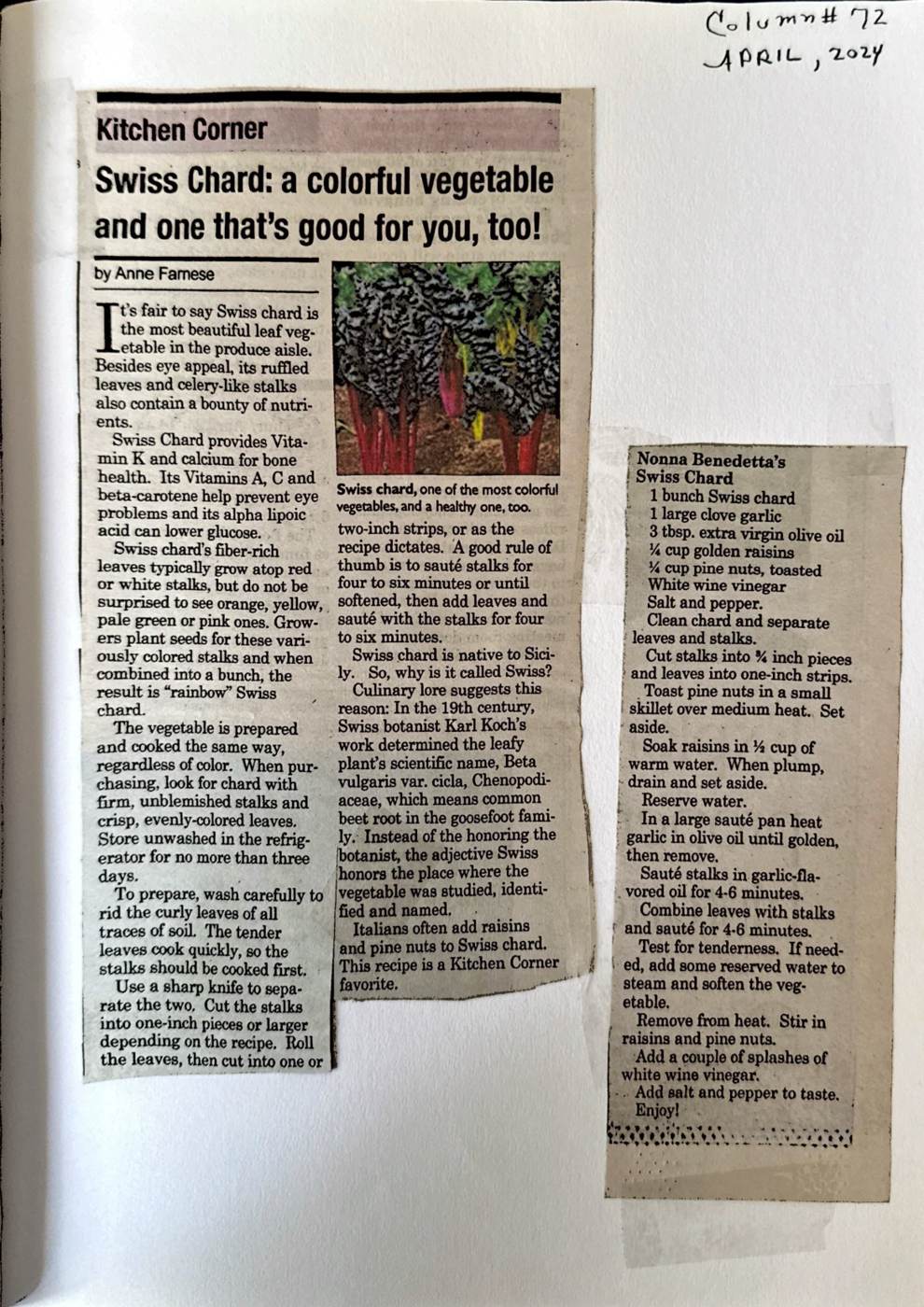
Swiss chard's fiber-rich leaves typically grow atop red or white stalks, but do not be surprised to see orange, yellow, pale green or pink ones. Growers plant seeds for these variously colored stalks and when combined into a bunch, the result is "rainbow" Swiss chard.
The vegetable is prepared and cooked the same way, regardless of color. When purchasing, look for chard with firm, unblemished stalks and crisp, evenly-colored leaves. Store unwashed in the refrigerator for no more than three days.
To prepare, wash carefully to rid the curly leaves of all traces of soil. The tender leaves cook quickly, so the stalks should be cooked first.
Use a sharp knife to separate the two. Cut the stalks into one-inch pieces or larger depending on the recipe. Roll the leaves, then cut into one or two-inch strips, or as the recipe dictates. A good rule of thumb is to sauté stalks for four to six minutes or until softened, then add leaves and sauté with the stalks for four to six minutes.
Swiss chard is native to Sicily. So, why is it called Swiss?
Culinary lore suggests this reason: In the 19th century, Swiss botanist Karl Koch's work determined the leafy plant's scientific name, Beta vulgaris var. cicla, Chenopodiaceae, which means common beet root in the goosefoot family. Instead of the honoring the botanist, the adjective Swiss honors the place where the vegetable was studied, identified and named.
Italians often add raisins and pine nuts to Swiss chard. This recipe is a Kitchen Corner favorite.
[Photo caption: Swiss chard, one of the most colorful vegetables, and a healthy one, too.]
Nonna Benedetta's Swiss Chard
Ingredients
- 1 bunch Swiss chard
- 1 large clove garlic
- 3 tbsp. extra virgin olive oil
- ¼ cup golden raisins
- ¼ cup pine nuts, toasted
- White wine vinegar
- Salt and pepper.
Directions
- Clean chard and separate leaves and stalks.
- Cut stalks into ¾ inch pieces and leaves into one-inch strips.
- Toast pine nuts in a small skillet over medium heat. Set aside.
- Soak raisins in ½ cup of warm water. When plump, drain and set aside. Reserve water.
- In a large sauté pan heat garlic in olive oil until golden, then remove.
- Sauté stalks in garlic-flavored oil for 4-6 minutes.
- Combine leaves with stalks and sauté for 4-6 minutes.
- Test for tenderness. If needed, add some reserved water to steam and soften the vegetable.
- Remove from heat. Stir in raisins and pine nuts.
- Add a couple of splashes of white wine vinegar.
- Add salt and pepper to taste. Enjoy!
View the original clipping
vegetables ingredients-spotlight